Beyond the Copilot: What Total Agentic Sourcing Actually Looks Like

By
Victor Kushch
April 29, 2026

Today we're launching Total Agentic Sourcing, and the results our customers are already seeing using the Fairmarkit platform are the right place to start.
Boeing has eliminated 115,000 hours of sourcing cycle time annually across a procurement ecosystem spanning dozens of teams and categories. Emirates Flight Catering cut sourcing cycle time by 85 percent for MRO contracts where flight schedules are fixed, food safety is non-negotiable, and demand shifts daily. These are production results, in complex categories, at enterprise scale.
What’s next: Total Agentic Sourcing, and the customers I’ve mentioned are early adopters in private beta. Powering our updated platform is KIT, an intelligent copilot backed by a network of specialized agents, built for every sourcing workflow from a tactical $500 purchase to a $500M contract, in the same environment. Understanding why we designed it this way is worth it, because the design reflects something larger happening in enterprise AI right now.
The Copilot Era Isn't Over. It's Evolving.
There's a tendency in the AI conversation to treat copilots and agents as competing visions, as if the industry has to pick one. We don't think that's right, and Total Agentic Sourcing is built on a different premise.
Copilots changed how people interact with software. They made complex tools more accessible, surfaced recommendations that used to require specialist expertise, and reduced the friction of getting work started. That value is real, and it isn't going away.
What's changing is the scope of what AI can do beyond the interface. Deloitte describes this shift as the rise of a "silicon-based workforce" — digital workers handling bounded operational tasks while humans manage judgment, exceptions, and cross-functional trade-offs. The future of work isn't humans replaced by agents. It's humans and agents working in complementary roles, with AI handling the execution layer and people making the calls that require context, relationship, and accountability.
Procurement is one of the clearest places to see that model take shape because the work is structured, the rules are codified, and the outcomes are measurable.
Two Speeds of Sourcing, One Platform
Not every sourcing event is the same. That sounds obvious, but most procurement automation treats the process as if it is, and that's where brittleness creeps in.
KIT is designed around two distinct modes that reflect how sourcing actually works.
For tail spend and tactical purchases, the high-volume, repeatable events that consume a disproportionate share of procurement bandwidth, KIT can run the entire process autonomously, from intake through award. Intake is captured through guided dialogue. The right event is constructed automatically. Suppliers are matched from a database of 2.7 million, with compliance and diversity requirements embedded. The award happens when criteria are met. The team sees the result; they don't manage the steps.
For strategic sourcing, the model is different. Agents handle the time-consuming work — building event structures, gathering and normalizing bids, running TCO scenarios, applying compliance rules. But the KIT copilot sits alongside the category manager for evaluation and final decision-making: interactive bid analysis, scenario modeling, negotiation preparation. The human is in the loop where judgment matters — with structured evidence and clear rationale in front of them, not a black box output they're asked to trust.
This is what good human-in-the-loop design actually looks like. Not "AI does the easy stuff, humans do the rest." It's AI doing the time-consuming work across the full workflow so that human attention is reserved for the moments that genuinely benefit from it.
Usability Is a Design Principle, Not an Afterthought
One thing I've observed in enterprise software over the years: the more powerful the system, the more it tends to demand of the people using it. Procurement teams shouldn't need to become AI specialists to benefit from agentic sourcing.
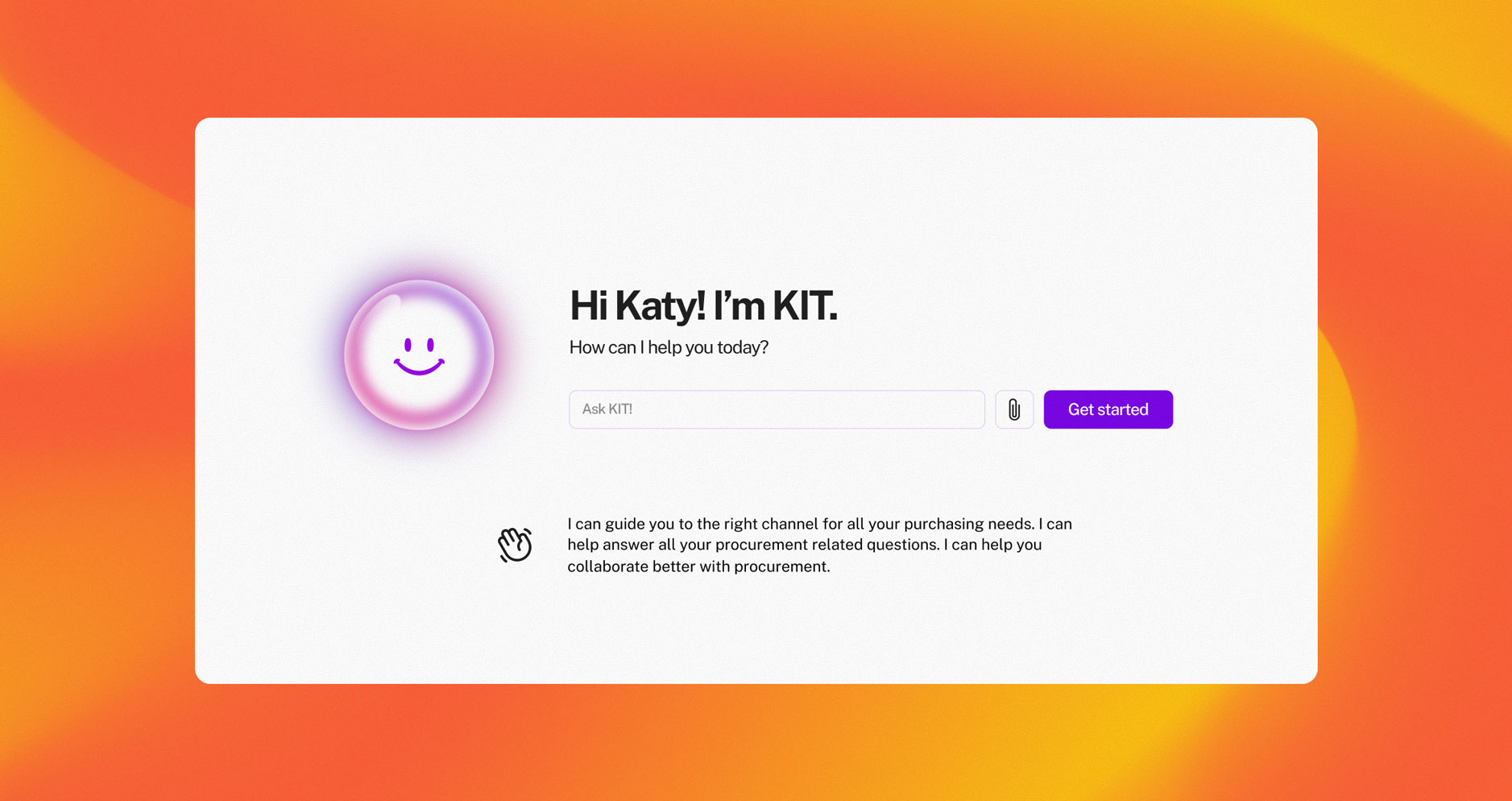
That shaped how we designed the KIT experience from the ground up. The Intake Agent uses conversational dialogue; requesters describe what they need in plain language, and KIT guides them to a complete, actionable submission. Evaluation happens through a chat interface where category managers can ask questions, model scenarios, and get answers without navigating complex menus or interpreting raw data.
The goal is that the system should feel simpler to use as it becomes more capable — not more complicated. Autonomy in the background, clarity at the surface.
Explainability is What Makes Trust Possible
The other design principle we've held firm on: you can't responsibly scale AI autonomy without visibility into what it's doing.
KIT has explainability built in. Every agent action, every supplier match, every compliance check is captured and traceable. When asking KIT for recommendations, users are able to interrogate why. As the research on enterprise agentic systems makes clear, explainability becomes operational when it's tied to specific sourcing artifacts (shortlists, event structures, TCO scenarios) not a generic explanation layer sitting on top of an opaque output.
This matters especially as more financially material workflows move through AI systems. Auditability isn't a compliance checkbox. It's the foundation of trust for procurement teams, for finance, for executives who need to know the process holds up to scrutiny. KIT is SOC 2 Type 2 certified, with zero LLM data retention and compliance rules that auto-apply by category, region, and spend threshold.
Safe autonomy and full accountability aren't in tension. They're the same design goal.
A Platform Built to Grow With You
KIT now ships with Model Context Protocol (MCP support), which is becoming the connective tissue for enterprise agent infrastructure. Looking ahead, this is central to our platform. Rather than brittle one-off integrations, MCP gives AI systems a standardized way to connect to APIs, enterprise workflows, and systems of record. It's a signal of direction: a more open, extensible platform where capabilities compose across the sourcing lifecycle rather than being locked into a fixed workflow.
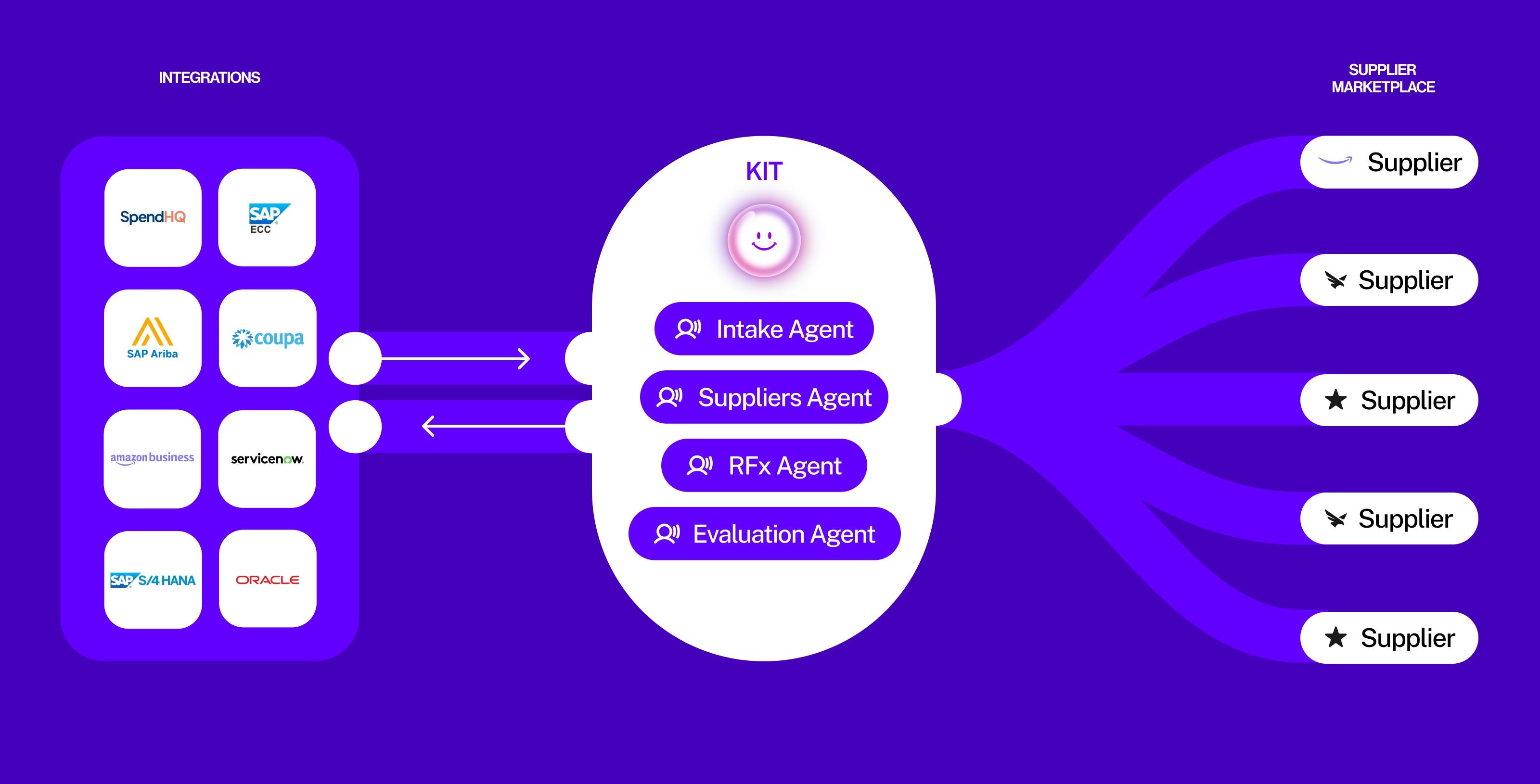
Native integrations with SAP Ariba, SAP S/4HANA, Coupa, Oracle, and ServiceNow mean KIT meets enterprises where they already operate. Requisitions are picked up, sourcing events run, and results write back — no manual handoffs, no parallel systems to maintain.
What the Results Are Telling Us
Only 12 percent of enterprise procurement have achieved widespread AI adoption, according to The Hackett Group. Fairmarkit customers are in that 12 percent, and the gap between them and the rest of the market is widening.
The reason isn't that they found better AI. It's that they stopped treating AI as a project to manage and started treating it as how sourcing gets done. That distinction — AI as operating model rather than initiative — is what separates organizations building durable competitive advantage from those still running evaluations.
Total Agentic Sourcing is where that operating model becomes available to every enterprise. The copilot is there when you need it. The agents are running in the background when you don't. The work gets done either way.
That's what we built. It's here.