Finance Shouldn't Meet Your Savings at the End.

By
Shane Hetrick
November 25, 2026

Procurement negotiates a better price. Procurement reports the savings.
Finance asks how it was calculated.
And somewhere between those two moments, the number loses credibility.
If you’ve worked in sourcing, you know how this goes. Procurement reports value, finance challenges the calculation, leadership discounts the number, and confidence in the savings pipeline weakens.
The problem usually isn’t the negotiation. It’s what happens around it.
Why Finance Questions the Number
Finance isn’t being difficult. It’s asking whether it can:
- Confirm the baseline
- Trace the award decision
- Connect the savings to actual spend
If it can’t, it does what any finance team would. It applies its own discount, counts only what shows up in the ledger, or rejects the claim entirely.
Meanwhile, the data behind the claim is scattered. Opportunities live in spreadsheets. Baselines are defined differently by each buyer. Forecasts rest on category-level assumptions. Sourcing happens in one system, the award is documented in another, and savings get re-entered into a tracker later.
Every handoff creates risk. Data gets copied incorrectly. Assumptions get lost. Pricing changes during negotiation, and the awarded value no longer matches the reported one.
Finance Shows Up Too Late
The most common failure is timing.
If finance only gets involved when procurement is ready to claim savings, there’s no room left to align on definitions, assumptions, or baselines. Disagreements about method surface at the worst moment, after the work is done and the forecast is already in leadership’s hands.
Savings work also starts well before an RFx goes out, often months before suppliers are invited to respond. Category teams are reviewing renewals, reading the market, and sizing opportunities. When that work sits in decks, inboxes, and individual files, the organization can’t see its own value pipeline.
Treat Every Opportunity as a Project From Day One
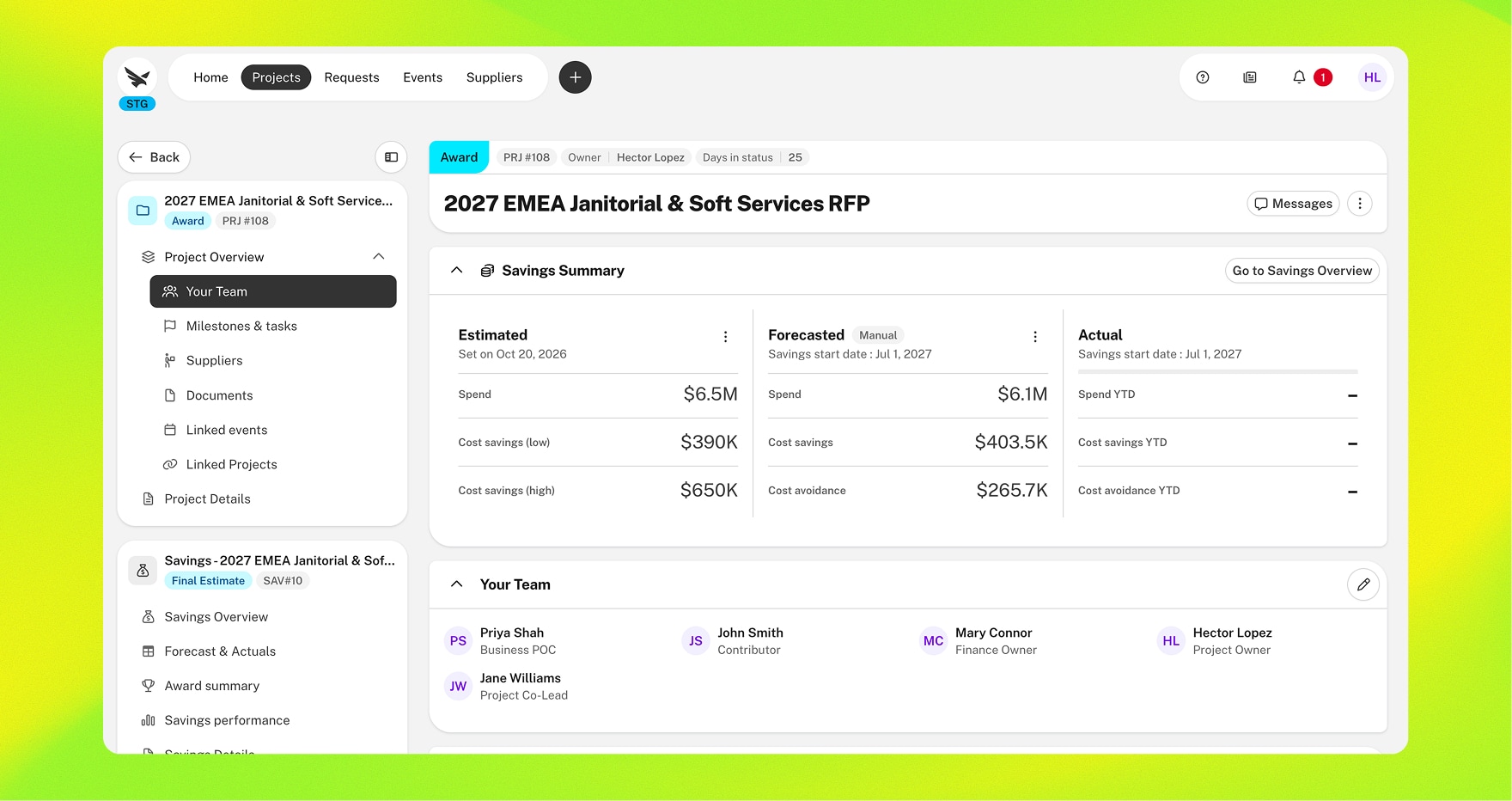
A stronger operating model starts every sourcing opportunity as a defined project. Each one captures:
- Business objective and category
- Stakeholders and target timeline
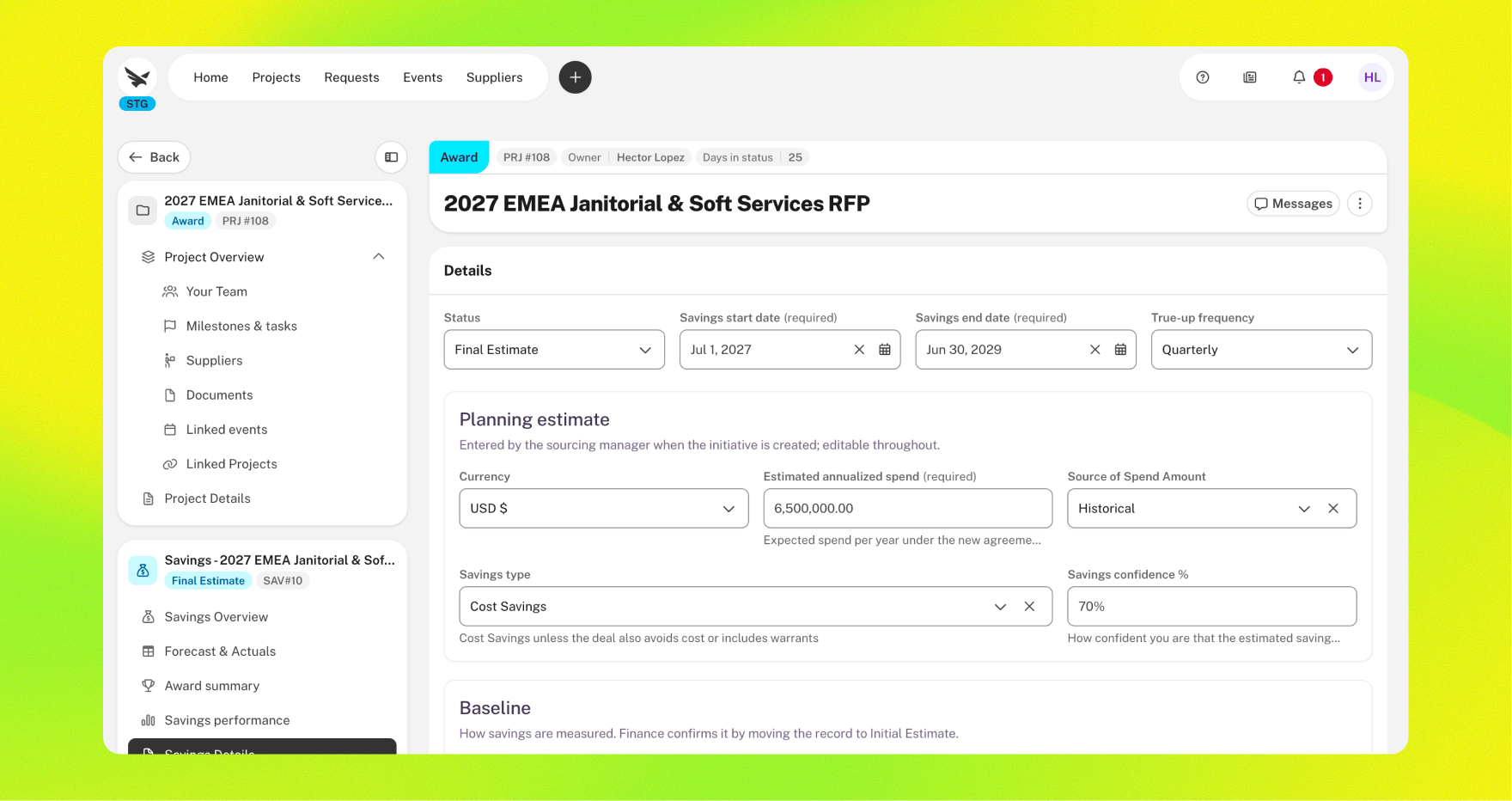
- Expected value, baseline logic, and assumptions
- Tasks, owners, and required approvals
Then it brings finance in early, before negotiations are complete.
That’s a small change with a big effect. Savings are no longer challenged because the measurement approach was never agreed. The approach was agreed first.
A Financial Lifecycle, Not a One-Time Estimate
The shift underneath all of this is a change in how we think about savings.
Not a number you calculate at award.
A structured financial lifecycle: identification, baseline agreement, forecast creation, award validation, implementation tracking, and actuals verification. Each stage has clear rules and a named owner for the assumptions.
That gives procurement, finance, operations, and leadership one shared operating model.
In the next post, we’ll get into the piece that decides whether the rest of it holds: the baseline.
See How Finance-Ready Savings Work
Explore Relay and see how teams manage projects, baselines, and savings in one place.