Sourcing Shouldn’t Have to Fit the Software

By
Shane Hetrick
October 29, 2026
For most of the SaaS era, we’ve asked procurement teams to adapt to their technology.
The software gave us structure, standardization, and scale—and those were meaningful improvements. But there was a tradeoff. Category strategies, policies, workflows, and even supplier responses often had to conform to however the application was designed.
You had a complex services event? Find a way to turn it into a questionnaire.
A supplier had a nuanced commercial proposal? Ask them to put it into your spreadsheet.
Your category required a different sourcing process? Configure the closest workflow the system could support.
We got very good at making procurement fit the software.
AI gives us an opportunity to reverse that relationship.
Instead of asking how procurement can fit into a predefined workflow, we can start with a different question:
What problem are we trying to solve—and how should technology adapt to it?
The Next Generation of Sourcing Software Has to Be Flexible by Design
Procurement isn't one process.
Tail spend doesn't operate like strategic sourcing. Logistics doesn't look like SaaS. A simple spot buy doesn't require the same workflow as a complex services engagement.
Yet historically, sourcing technology has needed structure to function. The more complex the category, the more work procurement often has to do translating reality into something the system understands.
AI changes that equation.
Take a complex sourcing event. Instead of requiring procurement to perfectly structure every question, line item, and commercial field before inviting suppliers, a buyer could define the things that actually matter—the drivers of the decision.
Pricing structure. Security. Implementation. Service levels. Capacity. Whatever matters for that category.
Suppliers could then respond in the format that best represents their offer, while AI works behind the scenes to extract information, identify gaps, and normalize those responses for comparison.
That's a very different experience from forcing every supplier into the same template.
And it's one of the ideas we're exploring at Fairmarkit through what we're calling Open Sourcing: preserve structure where it creates value without requiring every sourcing scenario to start with rigid structure.
The bigger principle matters beyond any individual feature: Standardize the outcome, not necessarily every input.
AI Needs More Than Intelligence. It Needs Context.
There's another misconception about enterprise AI that I think we're starting to move past: that the model itself is the product.
The model matters. But in enterprise sourcing, intelligence without context isn't particularly useful.
An AI system needs to understand how your organization operates.
What are your policies? What does your category strategy say? Which suppliers are approved? What happened in previous events? What tools can the AI access? When should it act automatically, and when should it escalate to a person?
At SOAR26, Victor Kushch and I described this as the harness around AI: the environment that gives agents the context and boundaries they need to be useful.
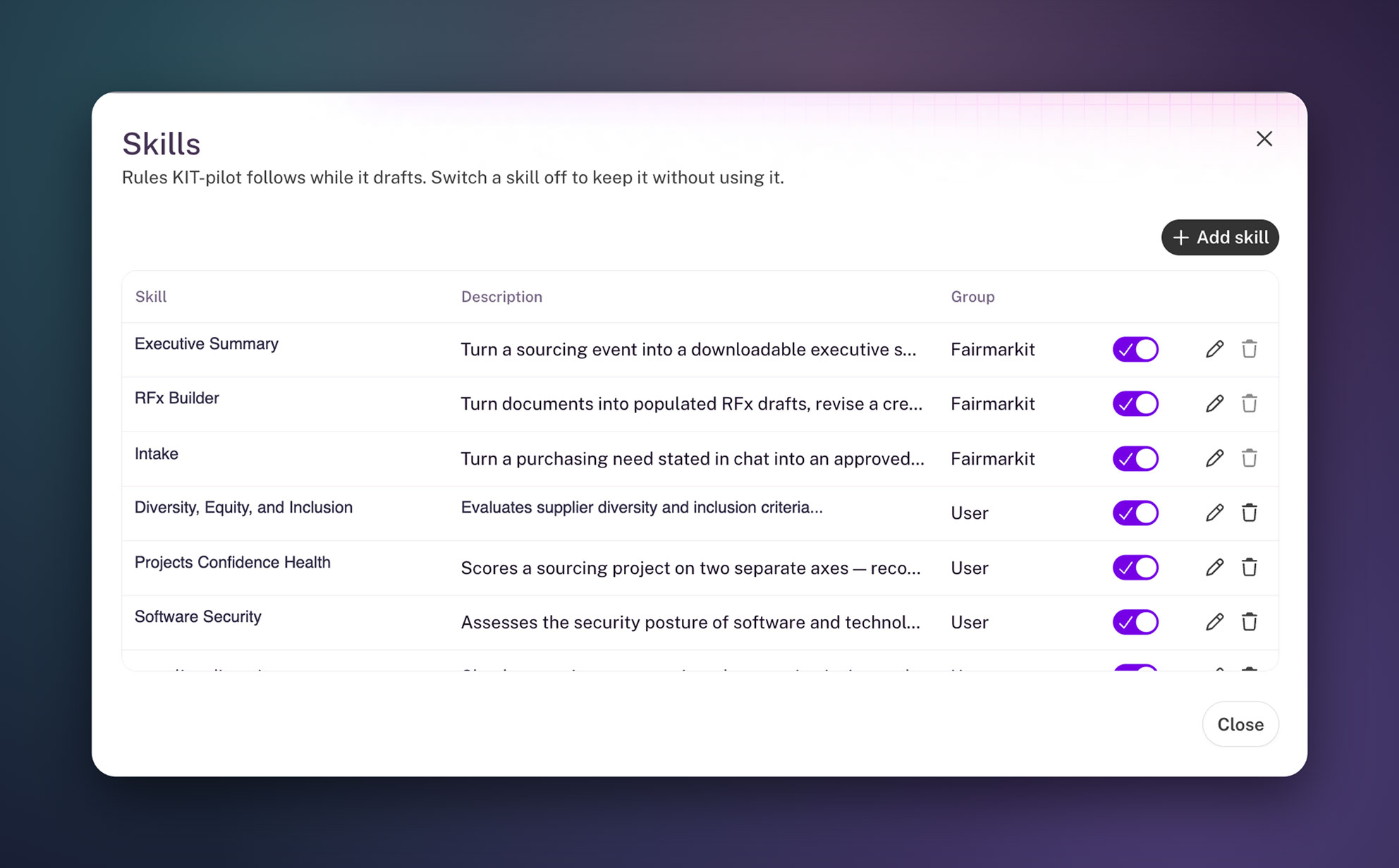
That includes skills that encode how work should be done, tools that connect agents to the information and systems they need, and routines that allow work to happen without someone continually prompting the system.
Imagine turning your best category playbook from a document someone has to remember to reference into something an agent can actually execute.
Or instead of a sourcing manager remembering to check every event for unanswered supplier questions, the system does it on a schedule and only brings forward what requires attention.
That's when AI starts moving beyond a better interface.
It begins to become part of the operating model.
The Workflow Shouldn't Fall Apart After Round One
Flexibility also matters once an event is underway.
Most sourcing platforms are pretty good at round one: collect requirements, invite suppliers, receive responses.
Then real life happens.
There are clarification questions. A supplier revises its proposal. A stakeholder wants something changed. Someone sends an email. Another person opens a spreadsheet. Decisions start happening in meetings and chat threads.
Suddenly, the sourcing platform has only part of the story.
That's especially problematic because multi-round sourcing is often where the most important work happens.
The future should look much more continuous.
Feedback should stay attached to the relevant response. Changes should have history. Supplier communication shouldn't require procurement to reconstruct context across five different tools. And AI should be able to understand that history well enough to identify what changed, what looks unusual, and what deserves attention.
That's the thinking behind the Continuous Sourcing capabilities we're building: keep the context of a sourcing process intact as it evolves rather than treating an event like a one-time transaction.
The Real Opportunity Is Moving From Reactive to Proactive
There's a broader shift underneath all of this that I'm particularly excited about.
Today, most enterprise software waits for you.
You log in. Find the event. Open the dashboard. Ask a question. Run the report. Figure out what needs your attention.
Even many AI experiences still work this way: open a chat box and ask it something.
But if the system understands your policies, priorities, workflows, and sourcing activity, why should you always have to ask?
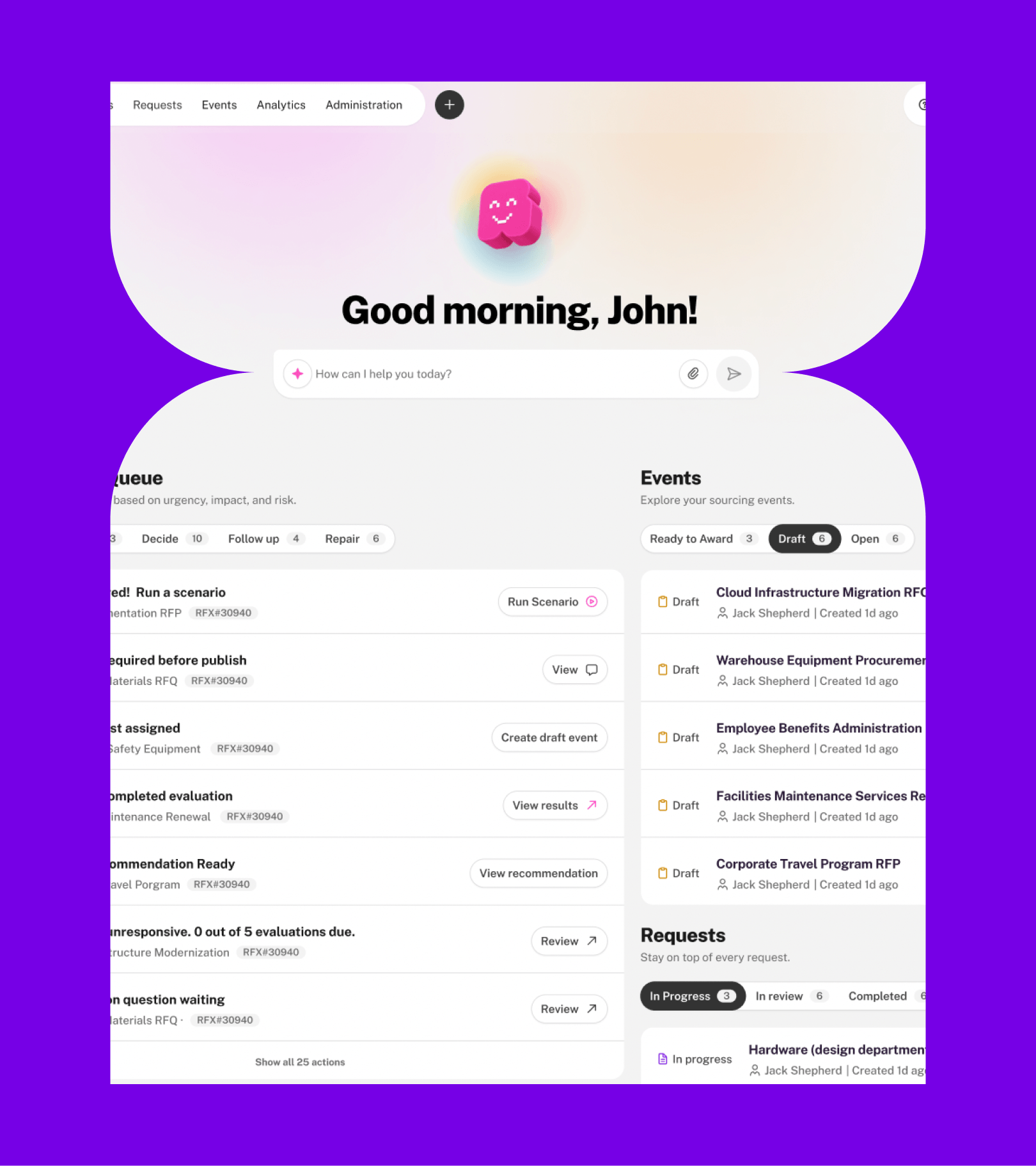
We're working toward an experience where the platform can build an action queue around what actually matters to you—surfacing the supplier response that needs attention, the event that's stalled, or the action that should happen next. And those actions can be driven by the routines and rules your organization defines.
That moves procurement from finding the work to deciding what to do about it.
For me, that's one of the most important changes AI can bring to sourcing.
Not another dashboard. Not another chatbot. A system that increasingly understands how your organization works and helps orchestrate the work around you.
And Ultimately, It Has to Show Up in the Outcome
Of course, none of this matters because it's technically interesting.
It matters if procurement can source more spend, cover more categories, move faster, improve outcomes, and demonstrate value to the business.
We're already seeing customers that have moved onto Fairmarkit's Adaptive platform drive 2–3x the sourcing volume through the platform, measured through spend or number of events.
But volume alone isn't the finish line.
Procurement also needs to connect sourcing activity to the value that actually materializes afterward. An award may show projected savings, but did those savings ultimately show up in invoices and spend?
That's one reason we're extending further into projects and savings measurement: connecting sourcing activity with downstream financial signals and using AI to help classify and validate realized savings according to each organization's definitions.
Because the measurement layer matters just as much as the intelligence layer.
If AI makes sourcing faster but we can't demonstrate a better business outcome, we've missed the point.
Build Around the Work, Not the Other Way Around
We're still early in this transition.
Some of the ideas we shared at SOAR26 are available today. Others are what we're building toward over the coming months and year. And they'll continue to evolve as we build alongside our customers.
But the direction is becoming clear.
For years, enterprise sourcing technology gave us increasingly sophisticated ways to put procurement into software.
I think AI gives us the opportunity to do something much more interesting:
Build software around how procurement actually works.
Let strategy define the process. Let suppliers communicate naturally. Let AI handle the translation and repetitive execution. Preserve context as work evolves. Bring the important decisions to the user instead of making the user hunt for them.
And measure whether any of it actually improves the outcome.
That's the future of sourcing software I'm excited to build.
See the Fairmarkit Product Roadmap from SOAR26
Watch Shane Hetrick and Victor Kushch's full SOAR26 product roadmap session for a closer look at the ideas and capabilities shaping the next evolution of Total Agentic Sourcing.
Watch the SOAR26 session on demand

One registration gives you access to the complete SOAR26 on-demand session library.